
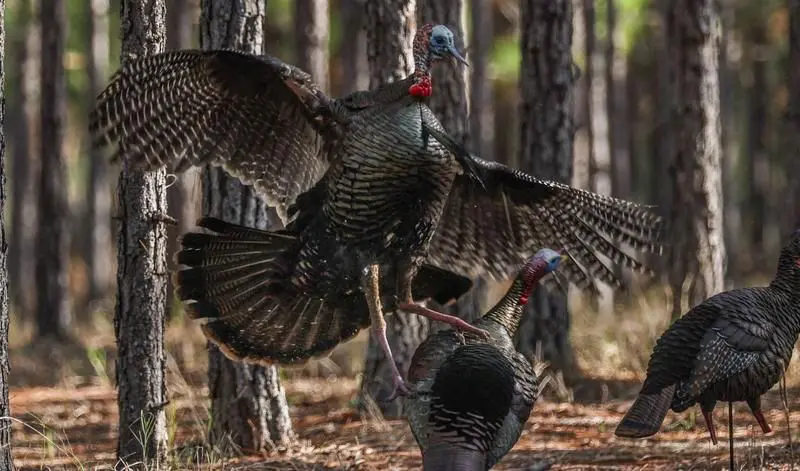
Early spring turkey season can be one of the most exciting times to chase gobblers. After months of winter survival, turkeys are transitioning into breeding mode, and their behavior revolves heavily around dominance and finding hens. Because of that, a well thought out decoy setup can be incredibly effective during the early portion of the season.
On many occasions, my early season hunting experience comes from taking kids during the youth only portion of the season, which is typically a week or more before the regular season. During this time, leaves are scarce, toms can still be grouped up, and the chances of a tom having a hen with him are higher compared to late April or early May.
During many of my early youth hunts, decoys were often the key to bringing gobblers into close range. I remember one hunt in particular where I had set up a lone hen, a half-strut jake, and a feeding hen decoy. It had been a slow morning, with toms quiet after flying down from the roost, as I sat in a blind with a young boy and his dad. Around 9:00 a.m., without a single call, three toms walked into the field from about 80 yards away. The moment they spotted the decoys, they came straight in. Thanks to that setup, the young boy was able to harvest his first turkey at just 15 yards. That hunt perfectly illustrated the power of a well placed decoy.
On that hunt, the turkeys came straight to the decoys without hesitation. But early season birds can be cautious; flocks are still loosely grouped, pecking orders are forming, and mature toms are often sizing up rivals. That’s why selecting the right decoy combination, like my two hen and jake setup, and placing them strategically can mean the difference between a bird that hesitates at 70 yards and one that charges in, ready for a showdown.
Read on for some of the most effective early season turkey decoy setups and when to use each one.
The Hen and Jake Combo
If there’s one early season setup that consistently fires up dominant gobblers, it’s the hen and jake combination. This is the setup I use for most of my youth hunts that occur during the early season. Sometimes I will add a feeding hen as well, which catches more attention from turkeys at a longer distance.
During the early breeding phase, mature gobblers are extremely territorial. When they see a young jake standing near a hen, they often stop what they are doing, as it triggers an aggressive response, pulling gobblers into range quickly.
As I mentioned earlier, when the three toms entered the field on our hunt, they were casually making their way through, not a care in the world. Yet, as soon as they saw the jake with two hens close by, tempers flared, and it was game on!
Why It Works
The visual of a jake near a hen creates two strong motivations:
Jealousy: A gobbler doesn’t want another bird breeding with a hen.
Dominance: Mature toms want to establish the pecking order early.
This setup can be deadly for birds that gobble hard on the roost but hesitate to come to calling alone, which is common in the early season.
Placement Tips
Place the jake decoy close to the hen, almost like he’s guarding her, or as if he is getting ready to breed. Keep both decoys within 20 yards of your position so a charging gobbler ends up well within range. Again, if you want to add another hen, use a feeding hen and place her 10 or 12 steps away from the other two, to provide a better visual when turkeys are farther away.
The Lone Feeding Hen Setup
Sometimes, simple is best. A single feeding hen decoy is one of the safest and most versatile setups you can run early in the season.
Early spring gobblers are often traveling with hens, but they’re still very interested in any lone hen they encounter. A feeding hen decoy signals safety and contentment, two things that naturally attract turkeys. I also like this setup when there are a lot of birds on one property. If a tom is used to encountering several hens and gobblers together, it is constant competition. Yet, if one hen is singled out away from the flock, it’s a chance for the tom to check her out, with no one fighting against him.
This setup works particularly well when hunting pressured public land, calling to cautious or subordinate gobblers, and birds that are still flocked up early in the season.
Placement Tips
Position the lone decoy the same as you would the combination, 15 to 20 yards from your setup and slightly quartering away from you. This encourages an approaching gobbler to circle in front of your position, giving you a clear shot opportunity. Whether you are using a shotgun or a bow, the gobbler will be in range when he is at the decoy.
Because the decoy appears relaxed and non-threatening, gobblers often approach calmly and within range, unlike when they see a jake and come in ready to fight.
The Breeder Hen Setup
One of my favorite all time setups is a breeding or submissive hen decoy, with a jake. Whether it is early or in the middle of the season, this setup can be extremely effective. During the early portion of turkey season, when gobblers are aggressively seeking breeding opportunities, they will come in at a dead run.
These decoys lie directly on the ground, without a stake, to mimic a hen ready to be bred. When a gobbler sees this, the message is simple: time is running out, and the jake is about to beat him to the hen.
Why It Works
Gobblers instinctively move toward breeding opportunities, and the submissive posture of the decoy creates a visual cue that calling alone cannot replicate. This setup is particularly effective when toms are gobbling aggressively, also when birds are already separated from winter flocks, and when hunting in open fields or food plots with high visibility.

Placement Tips
Again, keep the decoy within 15 to 20 yards and in the open so the gobbler approaches facing away from you or quartering toward your shooting lane. Lay the breeder hen on the ground, then put the jake, inches away, directly behind her.
The Aggressive Strutter Setup
This is the most aggressive decoy strategy you can run early in the season and is my least favorite, yet it can still be effective. A strutter decoy represents a dominant tom that has already claimed hens. For another mature gobbler, this can be a direct challenge. However, this setup is not always the best choice. Subordinate birds may avoid a full strut decoy altogether. So, scout your birds, and ensure you don’t have a bunch of young birds who could spook at a full strut tom.
When to Use It
The strutter setup works best when hunting highly territorial birds or when you have located a dominant gobbler in the area. It can also be great when hunting wide open terrain where birds can see long distances.
Placement Tips
Place the strutter slightly off to one side of your setup, not directly between you and the direction you expect the gobbler to approach from. This encourages the approaching bird to circle and present a shot.
Decoy Placement Tips for Early Season Success
Even the best decoys won’t work if they’re placed poorly. Early season gobblers are still cautious, and small mistakes can cause them to hang up. Keep placement tips in mind.
– Always put decoys within shotgun and archery range, roughly 15–25 yards from your position. Many gobblers will stop at the decoy before committing.
– Think about visibility, turkeys rely heavily on eyesight. Make sure your decoys are visible from the direction birds are most likely to approach.
– Use terrain to your advantage. Set up where gobblers can see the decoys from a distance, field edges, logging roads, ridge tops, and food plots all work well.
– Face decoys toward you because turkeys often approach head on, meaning they will naturally walk toward your shooting lane.
Early season turkey hunting is all about understanding the social dynamics of the flock. Gobblers are establishing dominance, competing for hens, and reacting strongly to visual cues. By matching your decoy setup to the mood of the birds, you can dramatically increase your odds of pulling a gobbler into range. Whether you keep things simple with a lone hen, provoke a fight with a jake and hen combo, or challenge a dominant bird with a strutter decoy, the key is to read turkey behavior and adapt your setup accordingly.