Early April turkey season can be one of the most exciting and most challenging times to be in the woods. Gobblers are fired up, hens are active, and the woods are still waking up from winter. But one thing every hunter quickly realizes is this: there’s not much foliage to hide behind.
A few years ago, my home state of Missouri had a late spring. Many trees still hadn’t bloomed, and the usual leafy briars and saplings that make up the ground cover were thin and scattered. On the opening morning of turkey season that year, I managed to call a strutting tom across a long field in the distance. He was still a couple of hundred yards out, with several trees between us, so I figured I could slip a little closer and get into a better position if he decided to commit.
I was very wrong.
As soon as I eased over to a large oak where I thought the bird would approach, he instantly broke out of strut and sprinted back up the hill in the opposite direction. I know turkeys have unbelievable eyesight, but at that distance and with at least some cover I thought I could stay hidden. The scoreboard for that first morning read: Turkeys 1, Me 0.
When concealment is limited, turkey hunting becomes less about blending into lush spring vegetation and more about breaking up your outline and matching the terrain you actually have.
For some, a ground blind can replace the challenge, which is what I have often done when taking kids during the youth season, typically early April. However, some turkey hunters would rather not use a blind. For those hunters, below are some suggested ways to use camouflage effectively during the spring turkey season.
Early Season Challenges
Before you even pick your gear, take a look at what the woods actually look like in early April, in your hunting area. Do this a week or two before the season opens. Because, as I have seen in my nearly 30 years of turkey hunting, the weather, rain, and other important factors can fluctuate from year to year.
When scouting, don’t simply check if there are any green leaves on the trees. Instead, look at the gray and brown colors that can dominate the landscape. Look at the type of trees and how they can be used for cover. Imagine yourself setting up on a turkey in different locations, and what it would look like as you approach that spot.
Once you have seen what kind of cover and concealment you have to work with, then look at the foliage and see how much green is exposed. If the leaves are beginning to sprout out during the early part of the season, this means your camo shouldn’t be bright or overly green. Instead, you want patterns that mimic bark, dirt, and dead leaves. For example, early season, a camo pattern such as Mossy Oak Bottomland or Realtree Original, both of which have a lot of browns and neutral colors, is a good choice. If you were to wear a pattern such as Full Foliage from Mossy Oak, it would stick out like a sore thumb and not blend as well as it would later in the season. Match the colors of your camouflage to the time and location where you are hunting.
Choosing the Right Camo Patterns Throughout The Season
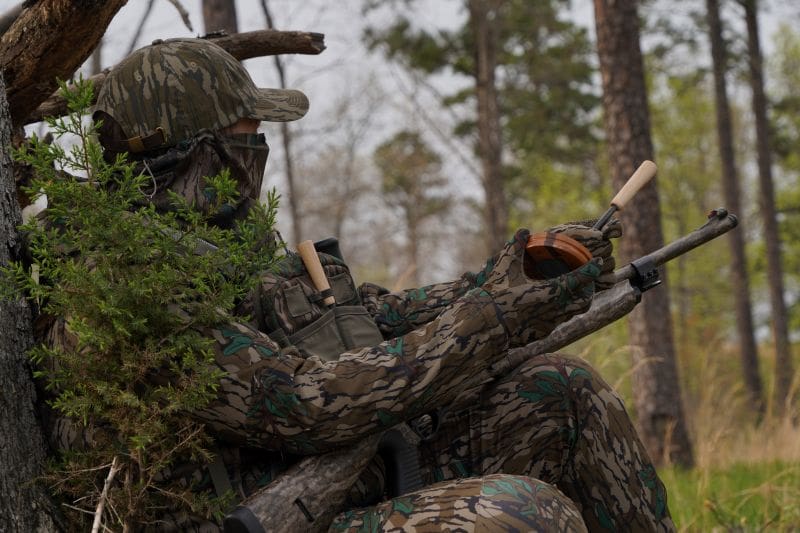
As mentioned earlier, the early season is where classic patterns truly shine. This is the time to lean into proven designs. As the season progresses, so will green and heavier cover. To help guide you, below are the patterns available in Blocker Outdoors turkey hunting clothing.
Realtree Original – Known for its photorealistic bark and shadowing, it blends seamlessly into hardwood timber. Great for early season, when cover is limited, or later in the season, when hunting in the timber.
Mossy Oak Bottomland – A go to for early season, its darker tones and tree trunk focused design help you disappear against big timber. And it is a great all around camouflage. Again, when hunting in the timber, it will be most effective.
Mossy Oak Greenleaf – This pattern is close to original Bottomland yet, with a few small green leaves. This is an excellent pattern for early and mid-season, when green leaves are in their early growth stages.
Mossy Oak Full Foliage – While it introduces a bit more green, it still works well in areas where early vegetation is popping, all the way through late season when green foliage is full grown.
Layer Smart with Performance Gear
Your camouflage is most effective at keeping you concealed from the wild turkey’s eyes. Yet, that is not the only reason hunters need to wear quality gear. Early April mornings can be cold, but afternoons warm up quickly. That’s where layering becomes vital to staying comfortable when hunting in the field.
An ideal turkey hunting setup should include a lightweight base layer for moisture control during hikes, later in the afternoon, or late in the season when temperatures warm up. A long-sleeve shirt such as the Finisher Turkey Long Sleeve Performance Tee is an excellent choice for all seasons.
Midweight outer layers that cut the wind without overheating are great during the middle of the season. Often, at first light, hunters can wear a jacket or a vest, such as the Finisher Turkey Fleece Lined Vest, to stay warm without getting too hot while walking or later in the morning.
Quiet fabrics that won’t give you away when shifting for a shot are a must while turkey hunting. Comfort matters more than you think, if you’re fidgeting because you’re too hot or cold, sharp-eyed gobblers will notice.
Break Up Your Outline
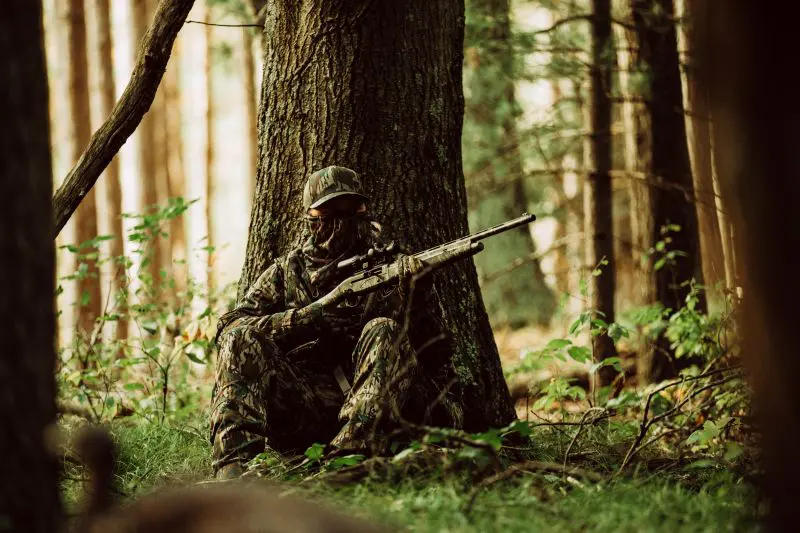
Turkeys rely heavily on spotting unnatural shapes, especially in a leafless forest. Even perfect camo won’t help if your silhouette screams “human.” To make sure you don’t get picked out, sit against wide trees that are broader than your shoulders, use natural shadows to your advantage, and keep your knees up to break the straight lines of your body.
As for must have clothing items, always add a face mask and gloves when camouflaging. Your skin is the biggest giveaway and can be like a white flag waving to a turkey’s eyes. Use the ground to your advantage. Without thick vegetation, the forest floor becomes your best friend. Sit in areas with heavy leaves on the ground and position yourself among fallen logs, stumps, brush piles, or anything that helps break up the human outline.
Add Concealment With Decoys
Turkeys key in on movement more than anything. In sparse cover, when drawing your bow or shouldering your shotgun, only move when the bird is obstructed or looking the other way.
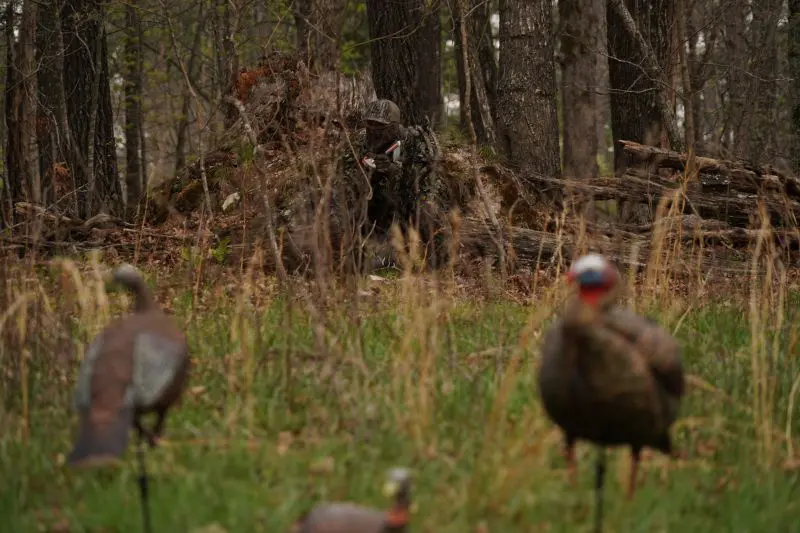
As an added protection against being spotted by a turkey’s eyes, use decoys to draw attention away from your position. The purpose of decoys isn’t just to draw a mature gobbler into close range; it is also a significant part of a turkey hunter’s concealment system. While hunting with kids in the past, it was amazing how much movement we were able to get away with, all because the turkey’s attention was locked on the decoys instead of watching for danger. Having 2 or 3 decoys in place on every hunt increases your chances of getting a tom into close range and making the shot.
Don’t Overlook Setup Location
Camouflage is more critical in turkey hunting than in any other wild game hunters pursue. But setup is everything in the early season. Hunters must set up closer than usual since you can’t rely on cover, avoid sky lining yourself on ridges, and position yourself with the sun at your back when possible, to stay in the shadows.
Early April turkey hunting strips things down to the basics. Without thick foliage to hide you, success depends on smart camo choices, proper layering, and disciplined movement. Master these details, and you’ll find that even in the most open timber, you can vanish and close the distance on a hard gobbling April longbeard.